Part 4: Nonprofits at the Protest

A protester wears a “Mayor Teargas” costume in CHAZ as pedestrians walk by. (Photo: Me, June 14, 2020)
Contents: Making protest friends; the intervention of nonprofits at the encampment
Note: These essays reflect the author's present recollection of events. Some names and characteristics have been changed.
There were several groups that formed within the encampment, most of which worked together. Some had beef with one another. But even where people had beef, or disagreed with each other's strategies, we generally didn't interfere with what anyone else was doing. Even if they were annoying or embarrassing, people left others alone.
We had a public stage at the protest where anyone could speak. Literally, anyone. Even people who were against the protest spoke there and told us that we should go home. (Certain media outlets loved that.) An audio system had been donated, so you could be heard by hundreds or thousands of people from the public stage.
It was after speaking on stage one day that I was approached by an individual who I'll call Leah. Leah was an active participant in the encampment. She asked if she could pay me for my speech, and gave me some rolled up bills. At the time, "pay Black women" was a popular slogan on social media and money was flowing around. I did not feel comfortable taking the money, but I didn't want to offend her. I assumed she gave me about $30. No big deal. I didn't look at the money until I got home later that day. It was several hundred dollars.
I felt pretty uncomfortable being given this much money by a stranger. The cash sat on my dresser for at least a week before I put it in the bank, having talked myself out of my discomfort. Unbeknownst to people in my life, by this point I was dipping into my retirement account to pay my bills.
After our first meeting, Leah often found me at the encampment or texted me to find her when I came to the encampment. I was following phone security guidance I found online - usually not bringing my phone with me to the encampment, or putting it in airplane mode. As time passed, and the police were not present in uniform, law enforcement felt like less of a concern than daily maintenance of the encampment. I became more lax with phone security so I could meet up with Leah.
Leah was a networker. She had a lot of friends, and made a lot of friends at the encampment. She introduced me to quite a few protesters who I didn't know yet. We got along well at first. We went to coffee. We went to lunch. I went with her to pick up her final paycheck from the job she'd quit so she could spend all her time at the encampment. I didn't let her walk me home when she offered, or come to my place, but she quickly became my encampment buddy.
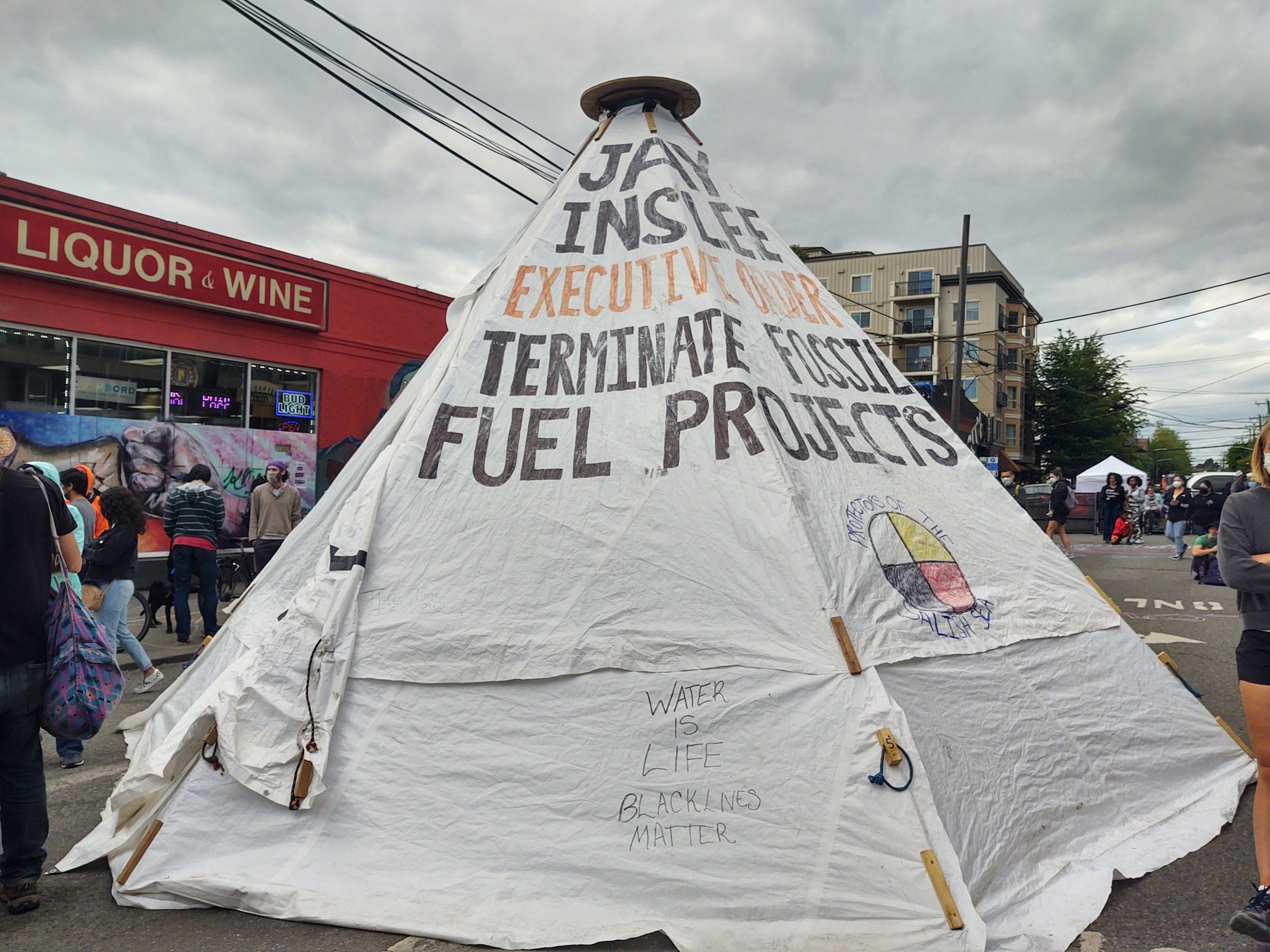
A tipi erected in CHAZ asks the governor to sign an executive order terminating fossil fuel projects. (Photo: Me, June 14, 2020)
By week two, there was always some sort of mini-crisis at CHAZ. Sometimes I would go with Leah to address issues that were going on. Other times we would meet up at a part of the protest I wasn't planning on spending time at, but I enjoyed spending time with her and I enjoyed most of the people she introduced me to. We even left the autonomous zone a time or two to go to other events happening elsewhere in the city.
Within four days of meeting Leah (between June 10 and June 13), I met several other people who came to influence my experiences that summer. One person ran Nonprofit A, a social justice nonprofit based on the East Coast. She was walking around the protest one day with a notebook. She handed me the notebook without saying anything. She'd written something like, "You have leadership potential in this space," on a piece of paper. The paper asked people to put their contact information down if they wanted to coordinate with other leaders. To be honest, I put down a piece of contact information because I wanted to see what she was up to. I was familiar with the regular faces at the encampment, and I had not seen her at the protest before.
I also met two people who ran Nonprofit B, a fledgling nonprofit operating out of Washington state. One lived in Seattle and the other lived out of town, quite a distance from Seattle. They were on the mic promoting their nonprofit when I first encountered them. The mission and programming of the nonprofit sounded pretty vague. They asked people to fill out a Google questionnaire, saying they were planning events for the stage and wanted to know what type of programming people wanted to see. I had never seen these people either. I found it weird that they were planning events for a stage that was open to the public when they were not active participants at the encampment as far as I knew.
And yet, there were thousands of people at the encampment every day. You couldn't know everyone.
Leaders for the Leaderless

A painted barricade in CHAZ (Photo: Tarika Powell, June 14, 2020)
Nonprofit A put together a meeting for protesters to talk about goals and organizing. It was a massive gathering at Cal Anderson Park. I'd never seen a lot of the faces who showed up. The meeting was run like a work meeting, complete with those giant sheets of paper with adhesive backing that you stick on whiteboards. It descended into chaos about halfway through when a Black woman objected to white people being present.
Personally, though I did not say so, I objected to her objection. I had seen these particular white people at the protest for weeks now, but had not seen her. To be fair, I have told white people to STFU or go away in the context of creating safe spaces, and would do it again. But I was not on board with excluding people who had been on the front lines, sometimes around the clock, for weeks. Why should they leave when strangers could stay just because those strangers shared one of my identities? Shared identity doesn’t guarantee safety.
That's not to say she didn't participate in the protests or had no right to raise her objection. There were protests and organizing efforts going on in other parts of Seattle as well, and have been for years, decades, and generations. This wasn’t even the first time there was an occupation that concerned the East Precinct. In 1981, activists occupied the proposed location for the East Precinct, at 23rd & Yesler, in Seattle’s historically Black neighborhood. The city abandoned the plan to build in that location. The precinct opened five years later in its current location.
The woman from Nonprofit A lost complete control of the meeting. There was a massive argument over whether the meeting should be all-Black or whether it was open to allies. Some white people were trying to get up to leave while Black people around them were pulling on them so they'd stay. An older Black lady who was a fixture at the encampment was recording it all into a hand-held recorder. The woman from Nonprofit A just kept talking amidst these loud arguments, until everyone who was dissatisfied left.
Strategies were discussed about organizing in a more cohesive fashion rather than everyone being an autonomous participant. I left about mid-way through, perhaps sooner.
The next meeting hosted by Nonprofit A was much smaller and took place in an alleyway. I happened to walk past this meeting, not knowing it was happening. Another protester, a familiar face at the encampment, grabbed me as I walked by and asked me to participate, saying the group could benefit from my knowledge and skills. I stayed for a few minutes then left, but not before noticing that one of the leaders of Nonprofit B was there, and she was glaring at the woman from Nonprofit A.

Another painted barricade reads “fight hard but stay soft” and “Black Lives Matter” (Photo: Me, June 14, 2020)
Out of these meetings, a collective was pulled together. The collective was all people of color except for a white leftist who was a member of one of those national socialist groups, and another white person who took notes at our meetings. Both of the white members worked most closely with Nonprofit A, and helped set up a lot of the basic structure for the collective. They started a Slack group. Many of the Black people I knew from the encampment were in the Slack, initially.
The collective was hastily organized within high pressure circumstances. There was more and more chaos every day at CHAZ. Plainclothes cops and feds were at work undermining us and creating confusion. People who were not feds were being fed-jacketed. The Trump administration was threatening action, and was publicly beefing with local political figures. There was a rumor of a sexual assault having happened at the encampment. We had a large unhoused population on our hands with mental health and addiction needs that we were not equipped to manage in any way. Our opposition was capitalizing on that in their portrayal of the encampment as lawless. Minor right wing media figures with YouTube channels constantly created disruptions.
My hope was that the collective could encapsulate some of the spirit of the protest and keep that spirit alive even after the protest ended. I bought in, in part, because it felt safer to be “in community” with a large group. I ran the collective's social media pages and wrote public statements, in addition to tracking media pertaining to collective members and training people on interacting with the media.
There’s a gap in my documentation of the encampment that coincides with the birth of this collective. I was always in meetings. I joined the communications team and the mental health team, but I went to meetings for most of the other teams because I had to coordinate with them. There were team meetings, whole group meetings, Zoom meetings, in-person meetings... there were more meetings per week than I'd had at most workplaces.
One of the people in the Slack group, who I didn't know, said the collective was too corporate and we were not really doing community organizing. I went off on them. I have since apologized, because they were right.
It took me a while to see that no real action was coming out of most of the meetings. It took me years to see the collective for what it really was. It brought as many Black protesters as possible into the same space and reduced our autonomy, giving us leaders and directives. That's not to say that this was the intention of the leaders of Nonprofits A & B; I don't know their intent. It's to say this was the only real outcome, and the outcome only benefited the state and the nonprofits.
Pulling the Black protesters into one space and separating us from other protesters was also a pattern I observed that summer from both the state and local Black leaders who were friendly with local officials. Both leaned heavily into messaging that divided protesters into groups, pinning all the negatives on white leftists and “outside agitators.” They amplified middle-of-the-road Black voices who believed "increasing Black wealth" was more effective than direct action, protesting, or other ways of putting pressure on the government to make changes. There were some "build Black wealth" centrists in the collective alongside people with radically different politics. The only things we had in common were being Black and supporting BLM.
You know what they say about hindsight.
In 2020, I was 39 years old, but I had not been involved in protesting or community organizing since college. I didn't realize the potential cost of trusting people who I met at a protest. I didn't know that if you go to a protest like this one alone, you should probably leave alone as well.
Last updated: May 21, 2026 for grammar and additional details on the 1981 occupation
