An Anatomy of Silence
Are bots being used to tank activists’ posts on social media?
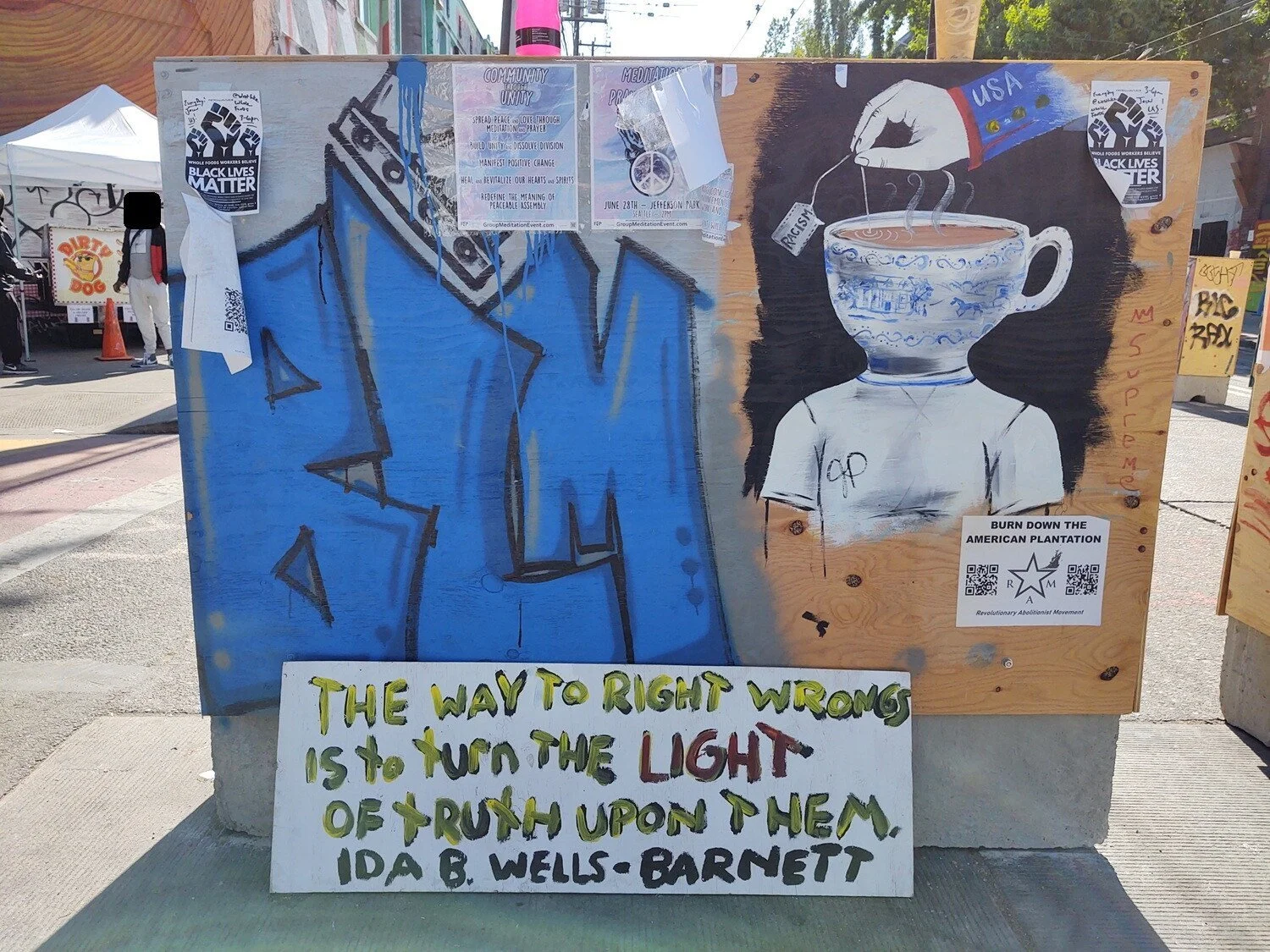
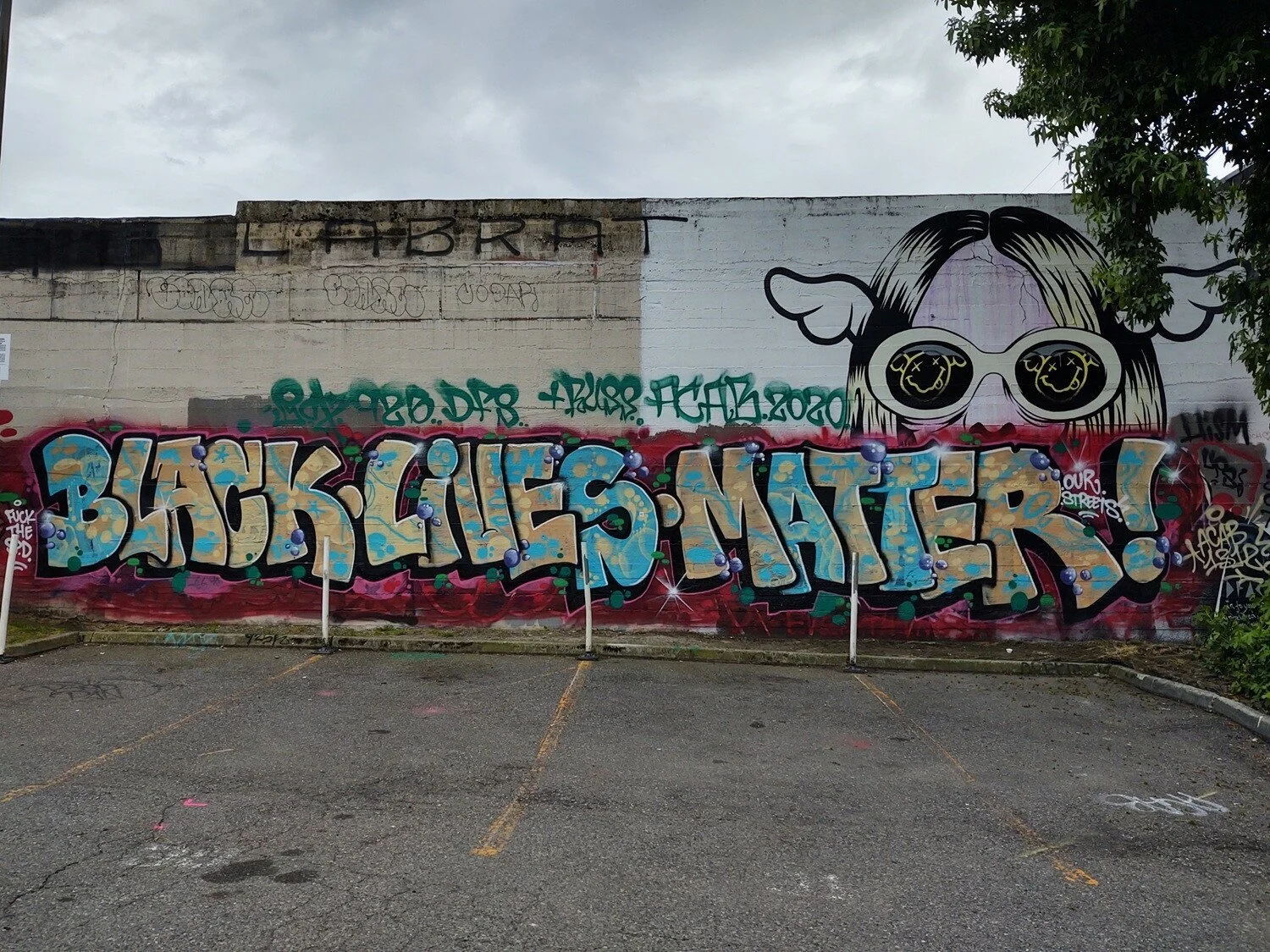
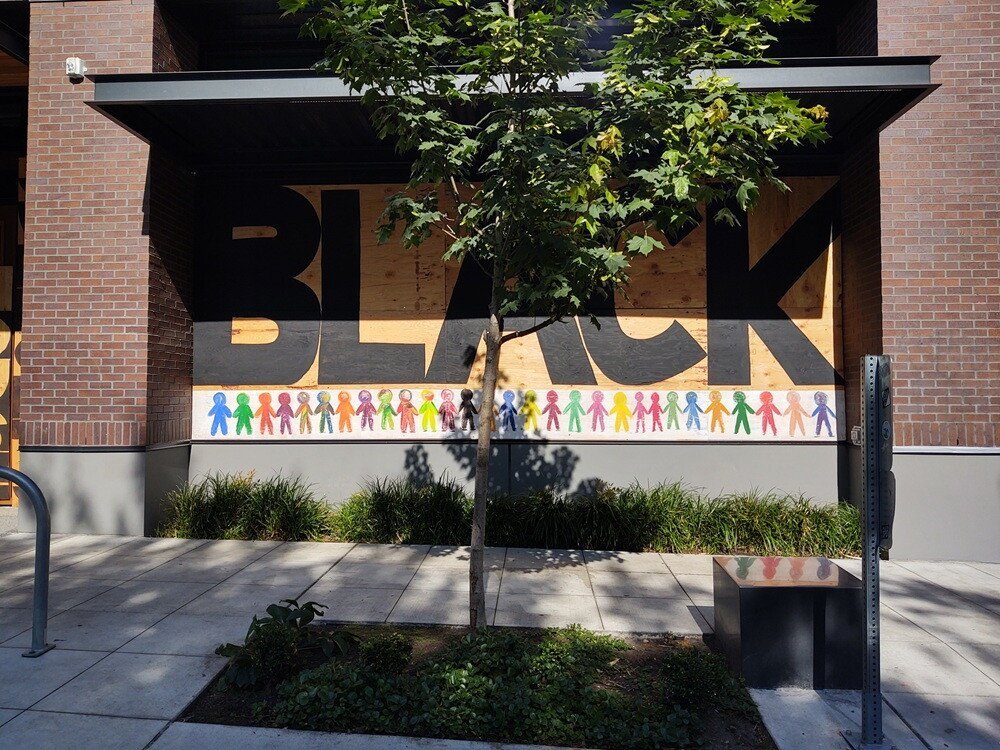
Barricade art in CHOP, photographed June 26, 2020. Photo: Tarika Powell
On May 29, I made an Instagram post about a murder in Seattle. It explained how a 19-year old was shot near a BLM protest in 2020, how protesters tried to save his life, and how “first responders” refused to help.
Initially, the post had a good deal of engagement for a small account. (Engagements are likes, saves, shares, reblogs, comments, and clicks on profile.) In 24-36 hours, it had around 900 engagements. Then the post inexplicably flat-lined on day two. Simultaneously, I noticed a lot of bot activity on my account, including fake-looking profiles and corn bots.
On June 11, I posted about a proposal some of my former acquaintances received in 2020 to meet with an elected Washington state Democrat and be awarded $1 million dollars. In exchange, they were to publicly walk Black activists out of the BLM encampment outside the East Precinct. The post talked about the night I found out about it, and my attempts to stop what was happening.
It reached relatively few accounts. Subsequent posts were shown to even fewer people. I had been shadow banned, and I think I was shadow banned because of the bots.
This post will analyze metrics and documented activity to explore my theory on what happened: that a malicious actor used bots to trick Instagram’s algorithm into reducing the reach of my posts.
Bot’s Landing
I’m currently writing a series about my experiences with federal and police harassment since protesting in 2020, called COINTELPRO in the Digital Age. I post excerpts from these essays on Instagram, which is my largest platform. The May 29 and June 11 posts were excerpts from the fifth and sixth essays in the series, called Grief and Capture, respectively.
Below is Instagram’s ‘Insights’ graph showing the literal flat-line for the May 29 post about my essay Grief. You see the views shoot up rapidly to 15,000, then the line takes a sharp turn and goes flat.
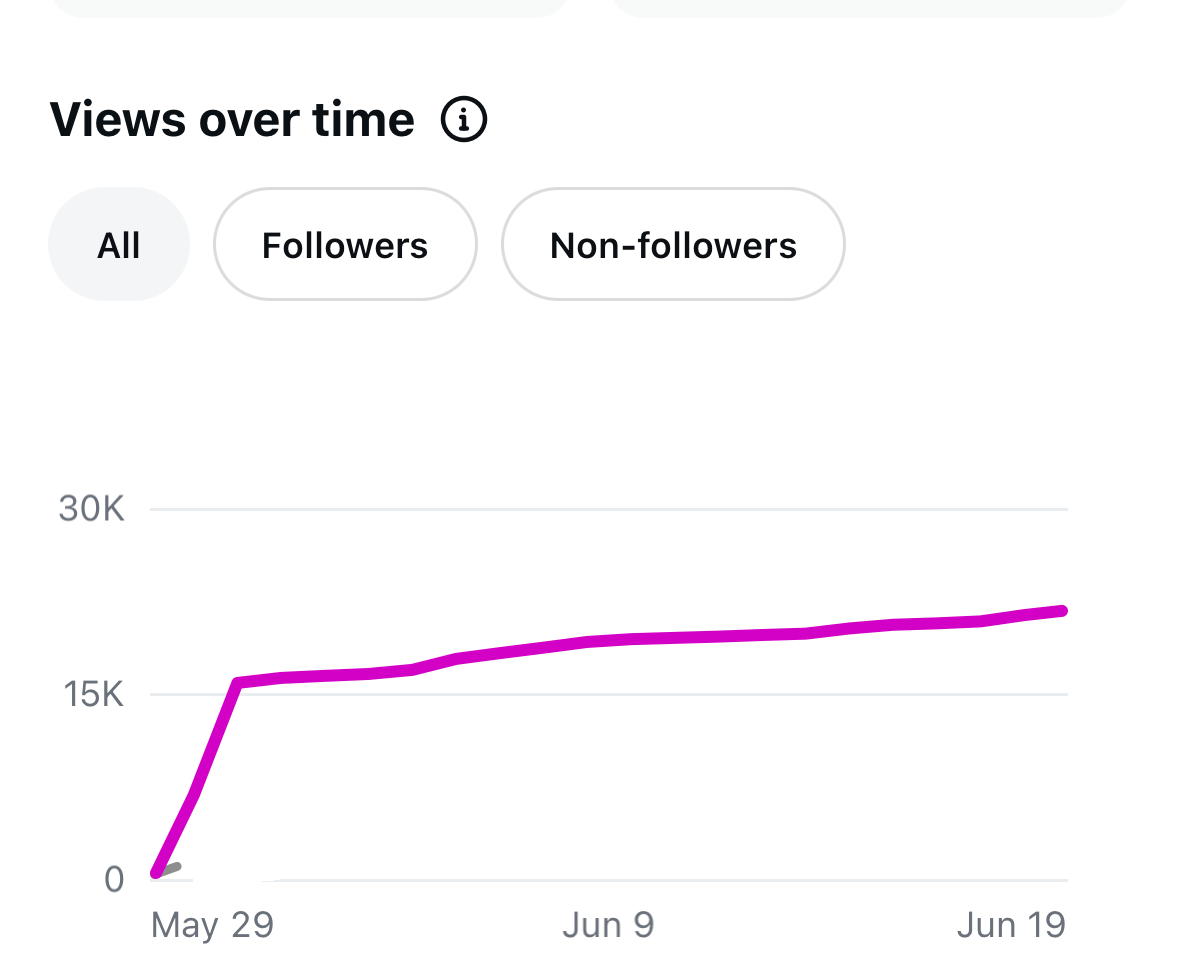
Purple line shows overall views for Grief from May 29 to June 19, 2026. A gray dotted line showing personal account data was removed in Paint with the eraser.
I’ll use “likes” as a universally-recognizable metric to demonstrate how my engagement rate changed after this post flat-lined. The post had over 700 likes within a day and a half, and about 150 shares and reblogs. It then took twelve more days to break 800 likes, and there was a steep decline in other metrics.
The way Instagram works, based on my research, is that your posts are shown to a small percentage of your audience, then their engagements push a post out to more people. If those people also engage, it will show it to more people, and so on.
Based on early and strong engagement, the algorithm should have pushed the post out to more people. Why would the algorithm kill it instead?
Let’s take a side-by-side look at the overall views of the post, views among followers, and views among non-followers.
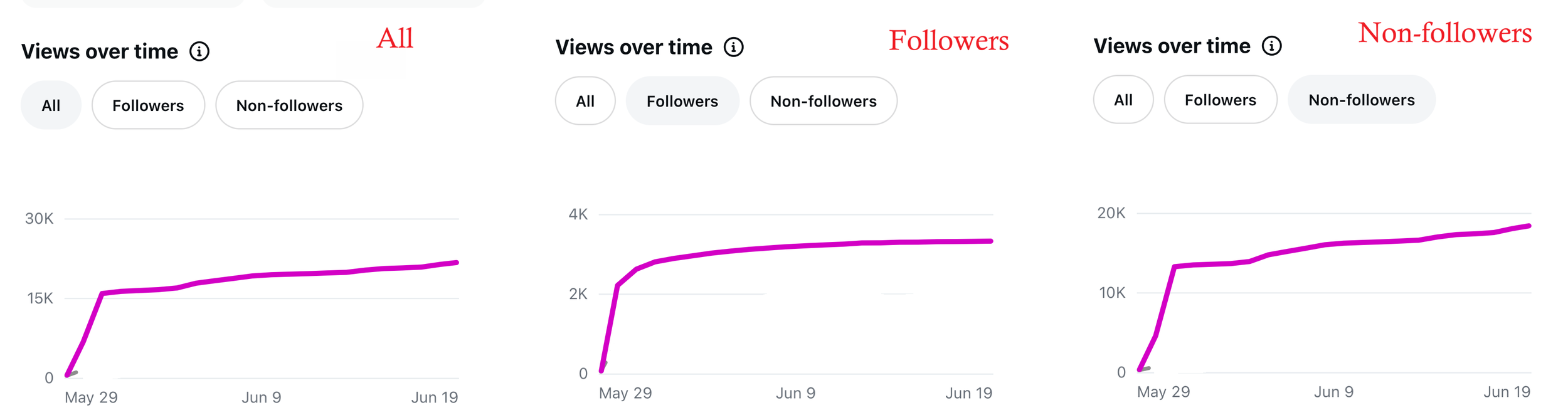
Purple lines show views for Grief from May 29 to June 19, 2026. A gray dotted line showing personal account data was removed from each chart using the eraser tool in Paint.
The overall metrics of the post are highly correlated with non-followers who showed up in high numbers within the first 48 hours, resulting in five times (5x) as many non-follower views as follower views. There were 13,000 non-follower views by May 31 compared to 2,600 follower views. When non-follower views flat-lined, follower views rounded off as well. Non-follower views stayed around 13,000 for four days, when views slowly started to increase again.
One could conclude that non-followers were just not interested in my content, but interest is measured in engagement. This graph shows views, not engagement. Engagement was good. It was a sudden nose-dive in views that seemed to have killed the post despite good engagement.
I observed bot activity at the same time this surge in non-follower views was happening. I noticed several new followers engaging excessively with my content. It’s not uncommon for new followers to look through your old stuff and like it, but I’m talking about rapid-succession likes indicative of automation or not actually reading the content.
The day after posting Grief, I made the following comments. The comments document corn bots viewing my stories, fake accounts engaging with my content, and interactions that seemed artificial.
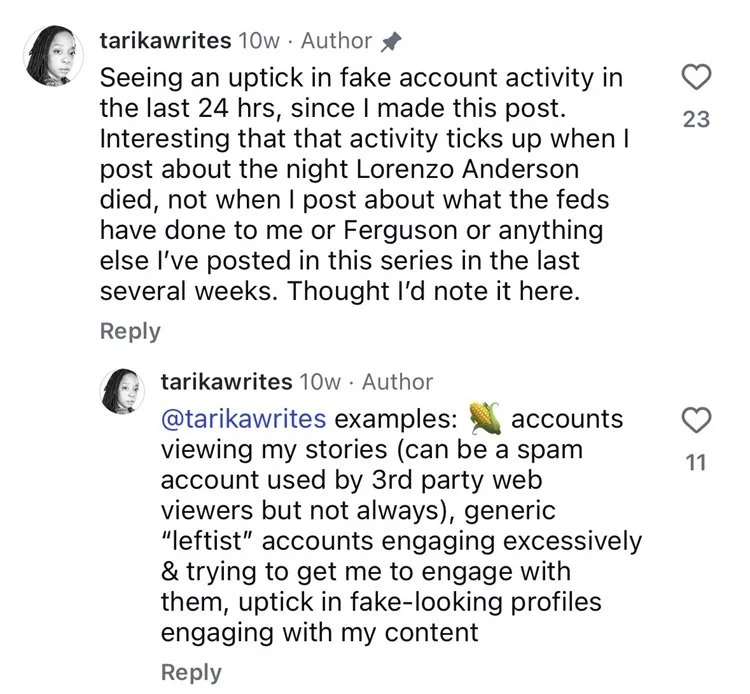
Two Instagram comments I made on May 30, 2026 document bot activity.
Another sign of bot activity on this post is that less than 70% of the views were from the US. In my five years of having this Instagram account, about 90% of the views on each of my posts have come from the US. Even my most popular post in the series, which reached over 50,000 accounts, had 91% of its views come from the US. Never have more than 30% of my views come from outside the US.
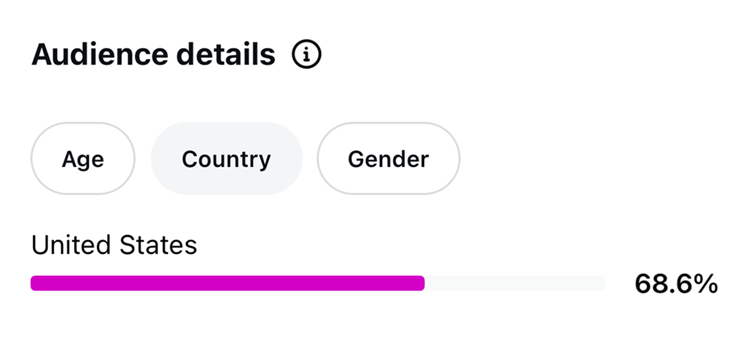
Screenshot of audience details by country for May 29 Instagram post called Grief shows less than 70% of views came from the US.
Odd countries doing numbers in your metrics is another sign of bot activity. The following graphic shows some of the countries that have represented an unusual share of my audience for posts made between December of 2025, when I shared reporting about FBI misconduct during Seattle’s BLM protests, and today.
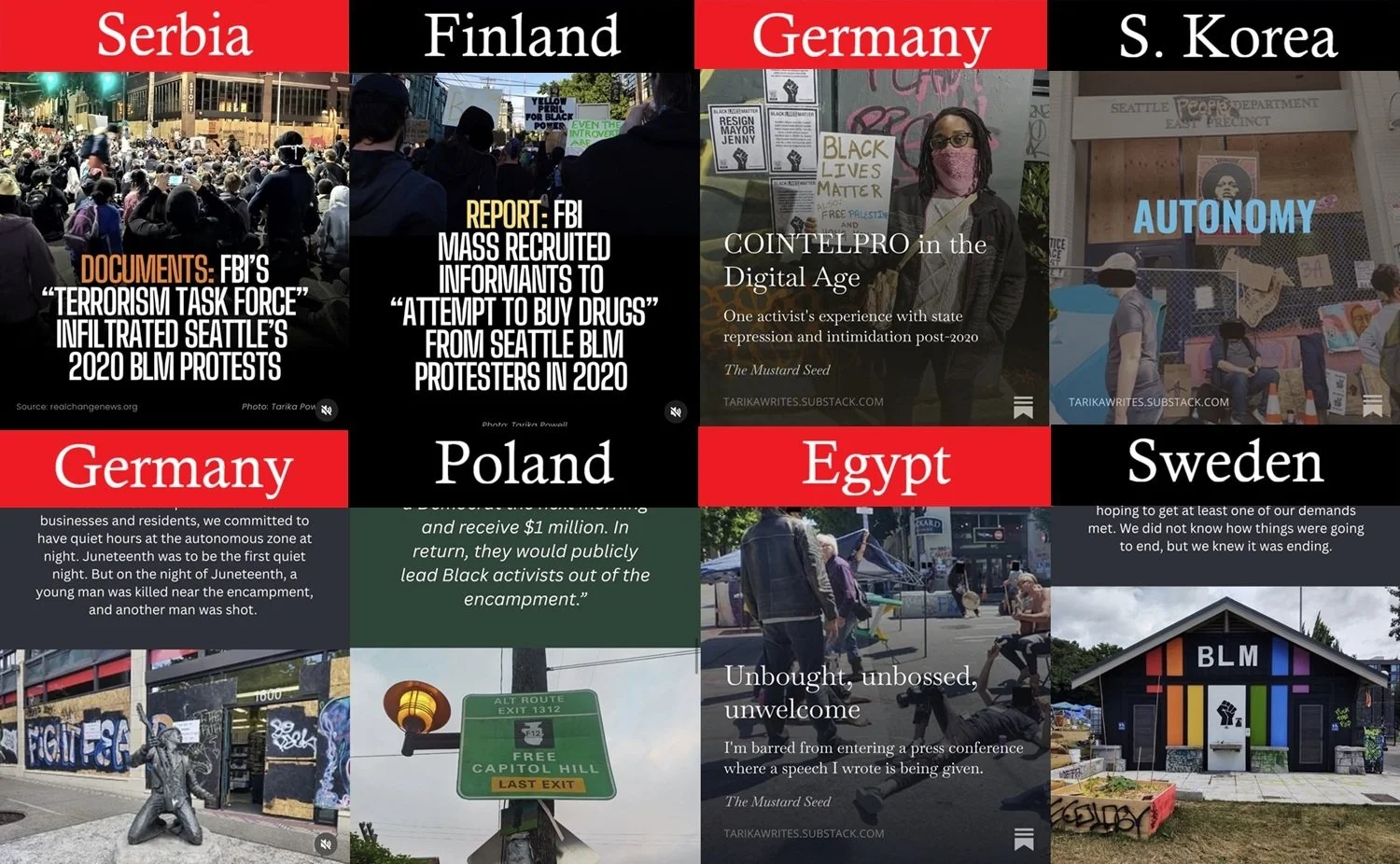
Countries that are not usually a significant part of my audience have been over-represented in my views for posts about the FBI and the COINTELPRO in the Digital Age series.
While certain activity caught my attention, I think the bigger threat to the visibility of my work may have been activity I was not seeing. I think my content was attacked by malicious viewbots, bots that view content but do not engage with it, driving down the reach of content.
Malicious bots & shadow banning
By the time I made the June 11 post, I’m getting four measly views on my Stories. The post was shown to relatively few people and did roughly 200 likes in the first few days. Among people who actually saw it, there were a lot of shares, but the shares didn’t seem to actually get the post in front of more eyes. It had a long tail and continued to get engagement for weeks, which was odd for a post that had low initial visibility. On my account, only posts that have had strong initial engagement have had that type of extended engagement and visibility. It was like Instagram users who were boosting the post were fighting the algorithm.
It looked very much like I was shadow banned. The next post in the series, Unbought, Unbossed, Unwelcome, was posted on June 15. It was shown to very few people. Using likes as an easily-comparable metric here, it got less than 100 likes in two weeks.
Three of the first five posts in this series broke 1,000 engagements, but nothing after the bot swarm did. Three of the first five posts had over 700 likes. Nothing after that broke 500 likes, despite the fact that I gained about 1,300 new followers specifically interested in this series, and my existing audience was also engaging. Most posts after the bot swarm didn’t break 300 likes. Several didn’t even break 100.
It didn’t seem like an organic drop based the level of interest in the series. Metrics can wax and wane, especially in the Metaverse, but I wondered whether this could have something to do with the bots.
We all know of people who buy bot followers, bot views, and bot engagement to artificially inflate their accounts. Instagram has cracked down on this by suppressing the reach of accounts that are caught using bots. One of the penalties they may apply is a shadow ban. The user is punished with a lower reach because Instagram assumes you are the one buying the bots to inflate your own metrics. Users may be shadow banned for a time period that Instagram gets to decide, and are left in the dark about it.
While researching social media bots, I came upon an article that mentioned “malicious view-botting.” A viewbot is a bot that gives views to content. Youtubers and streamers use them to inflate their audience numbers. On Meta platforms, viewbots can be harmful. Meta’s algorithm pairs views with engagement to decide whether to push out a piece of content or an ad to more people. Malicious view-botting is a tactic that businesses use to harm the ad reach of a competitor’s products. The malicious viewbots look at an ad but do not engage, which mimics user disinterest. This tanks the ad, interferes with ad revenue, and causes companies to waste money on ad spending.
Similarly, when lots of people view your posts but do not engage, that tells Instagram the content is not interesting, and would not be of interest to a bigger audience. It signals to the algorithm that it should not expand the reach of the content.
I think the job of the bots that swarmed my account on and after May 29 was to either mimic disinterest in my posts, tricking the algorithm into taking the posts off people’s feeds, and/or trigger Instagram’s bot suppression system, which unfairly suppressed my posts. Once the bot swarm did whatever they were programmed to do, you see non-follower views drop off, and fewer actual followers see the post relative to what was happening before the bot swarm. Meaning, real Instagram users were not able to see my post or amplify it among other real Instagram users. it
Thoughts, Theories & Caveats
I’ve actually seen some of these bot activities before, specifically the “big fan” bot. It’s possible that my content has been attacked like this before.
If my theory is correct, these bot activities are suppressing my right to tell my story. It’s an attack on my first amendment rights and other legal rights. These actions may be criminal, and are certainly malicious and indicative of an intent to use covert means to achieve silence.
Being shadow banned has a chilling effect on speech. It’s discouraging. If it’s a state actor triggering the shadow ban, that could be a form of psychological warfare to discourage activism, speech, or even a specific activist. These tactics could be used to make a person feel like no one is listening, when many people want to listen. They could be used to separate people from existing or potential community, and have a disparate impact on people who rely on online communication, including disabled or incarcerated people.
As an Instagram user, it harms me in multiple ways. Instagram is my biggest platform. It drives traffic to other platforms where I post long-form pieces that won’t fit on Instagram. It drives traffic to my support platforms. If someone is stopping my content from being seen on Instagram, they are also interfering with my ability to have people support my work. If my ability to make a living is being infringed upon, that could be criminal activity from a private actor and it’s fascist activity from a government.
More data would be needed to draw a conclusion instead of a theory, but I think there’s something here to be further investigated by people with expertise in this area. I would also encourage activists and Black and indigenous creators to look through their insights for odd activity. Documenting insights and collecting data could help us figure out whether there is broader evidence of malicious bots attacking activist, whistle-blower, or journalism accounts.
*”Bot’s Landing” is a reference to an old soap opera called Knots Landing. Severely dating myself with this pun.