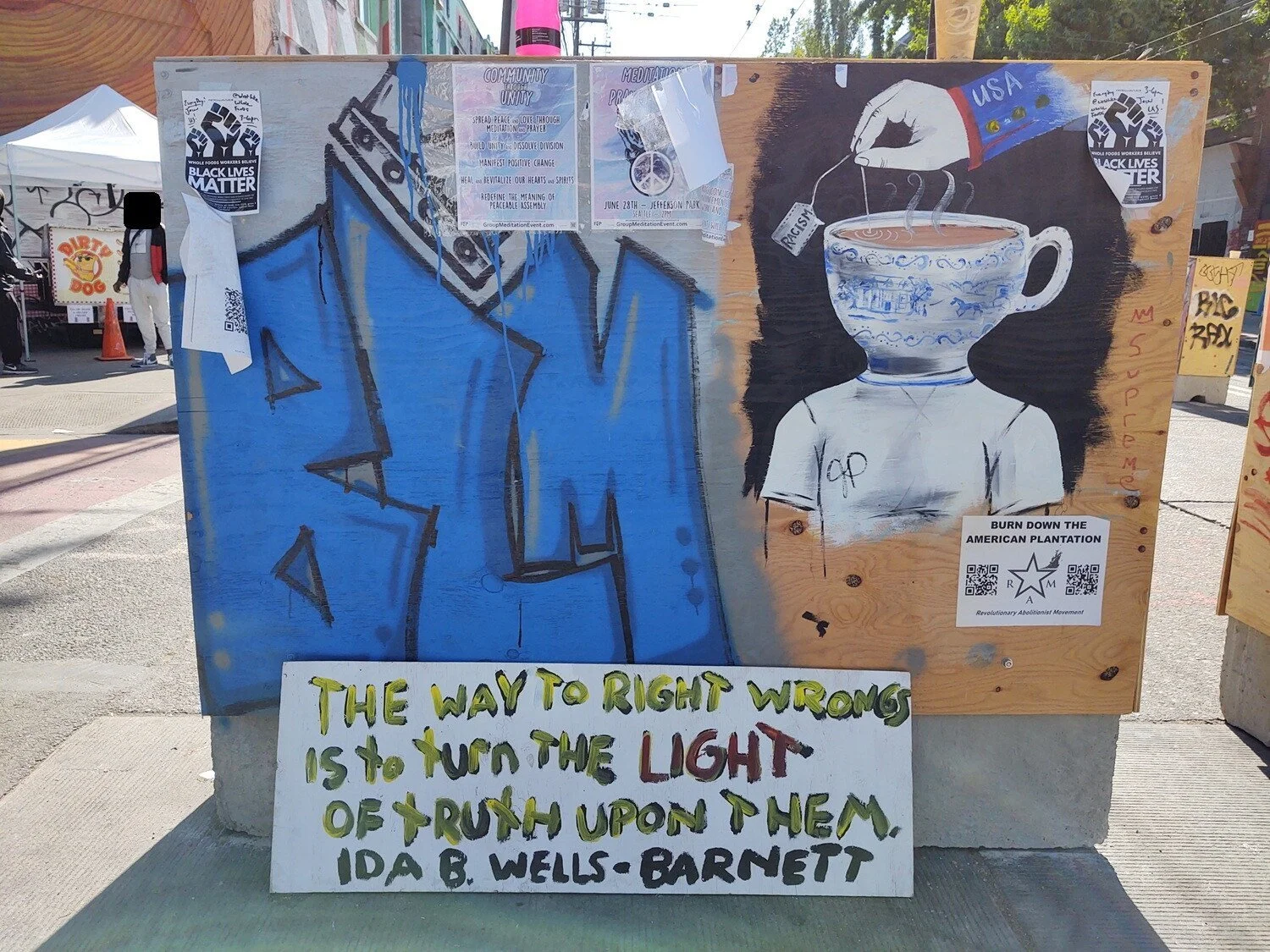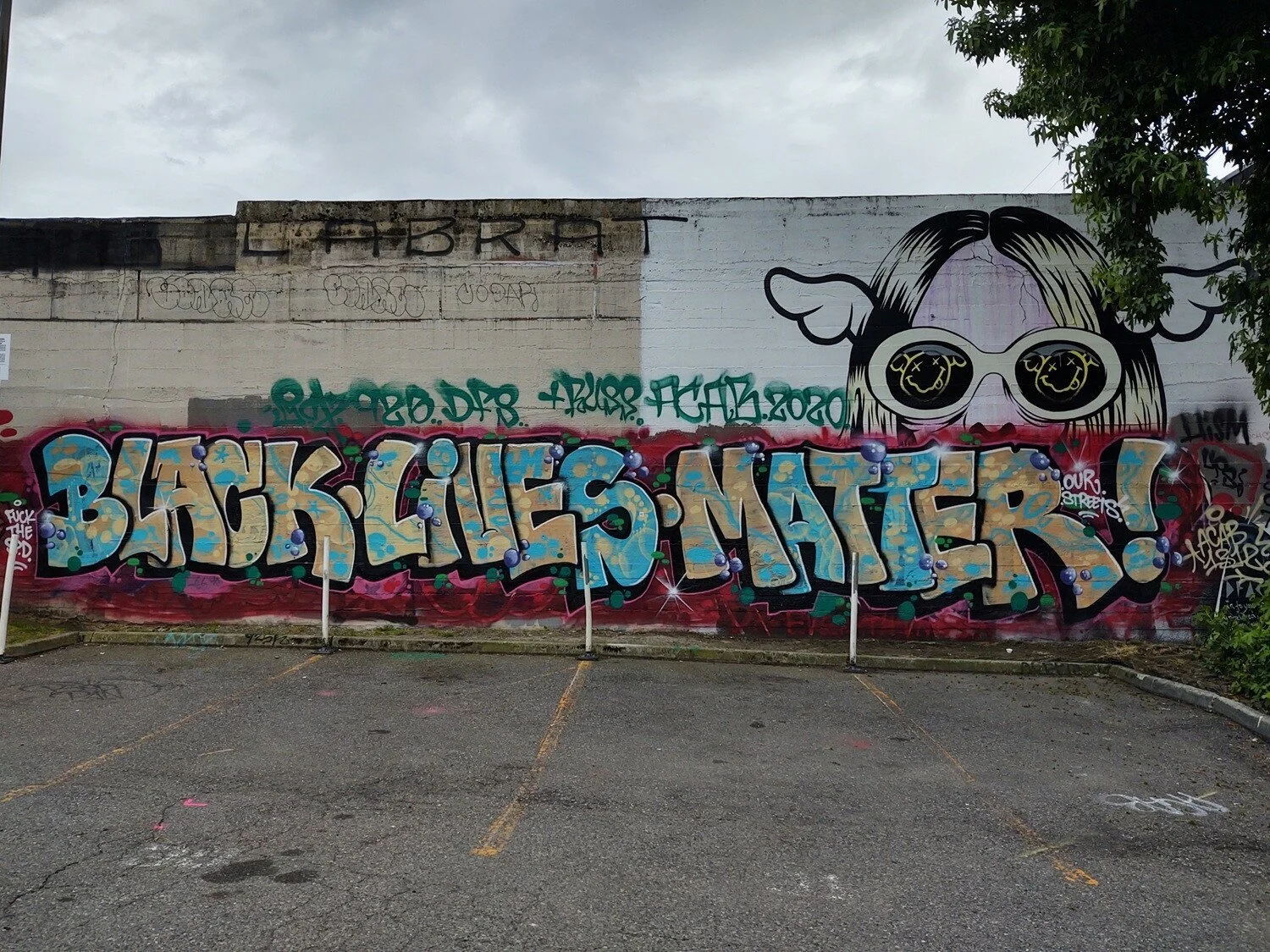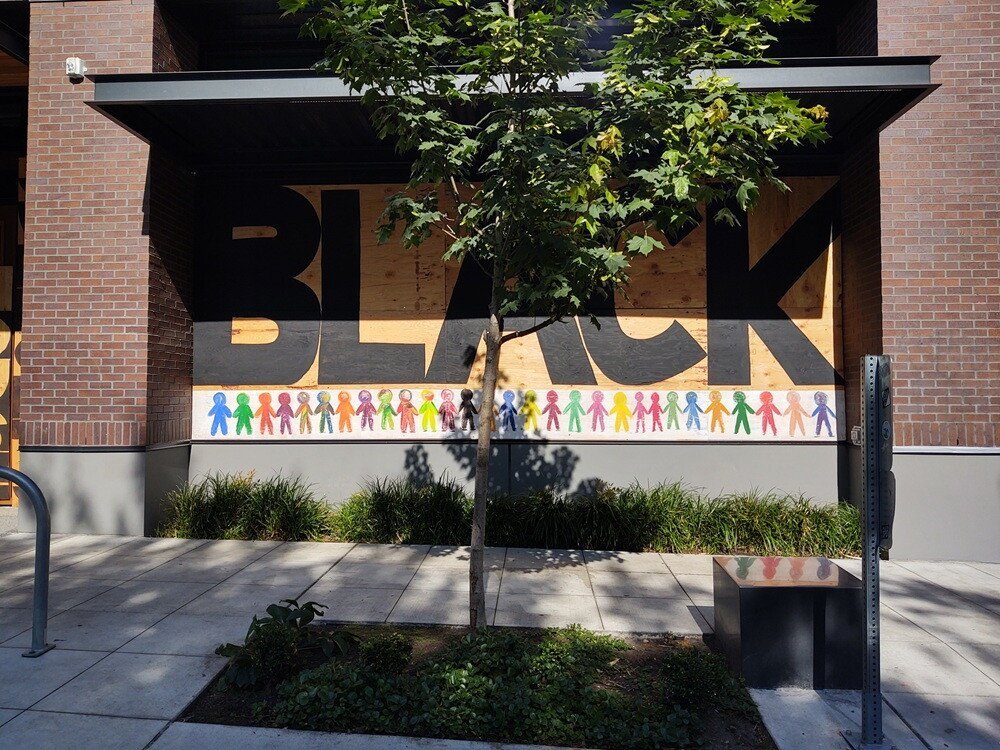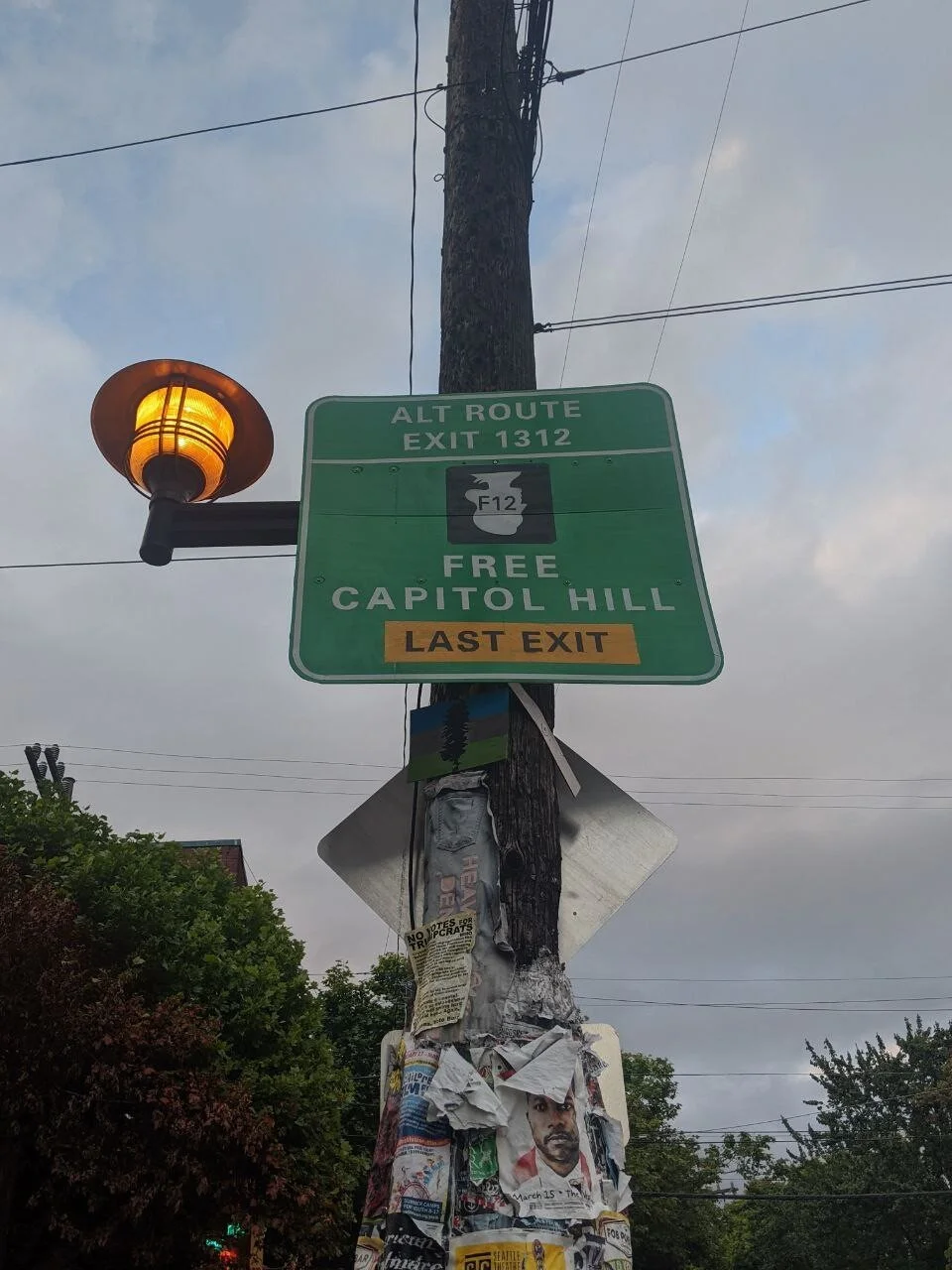
A modified highway sign at CHOP, photographed July 1, 2020. All photos: Tarika Powell
This is Part 6 of COINTELPRO in the Digital Age.
Contents: Formation of protest subgroups; a meeting with a local BLM leader results in a million-dollar proposal
Note: These essays reflect the author's present recollection of events. Some names and characteristics have been changed.
Previously in this series: Part 5: Grief
The pace was brisk in the newly-formed collective. It felt calm and organized compared to what CHOP had become. I ran the collective’s two social media accounts. I wrote press releases and did 1-on-1 trainings for members who had an interview or public appearance. I did most of our messaging. I fielded incoming emails and got them to the right person. I fielded incoming DM’s on social media. I spent about 8 hours a day doing media work for the communications team. It was a full-time job.
Our messaging started as a few sentences about how we were not tied to the encampment as our sole identity, how we'd "started at CHOP but were ready for the world." The comms team jazzed this up into a mission statement and other forward-facing communications like blurbs for our website and social media. Many of the other teams were planning an event that would take place at a public space far from CHOP. We were all quite busy.
There were several other groups that grew out of the protests. Once collectives and groups started forming, it felt like there was competition to be seen as the group that was “doing the work.” Sometimes I’d get a passive-aggressive DM via our social media from a member of another group. I’m not quite sure people knew who they were messaging, since I did not amplify myself on our socials, and the same people never approached me that way in real life. I only had beef with one person at the encampment, and that’s because I’d literally had to put my body between him and a woman he was acting aggressively towards. Still, I checked on him after the shootings to make sure he was ok. (For what it’s worth, another man kicked his ass for how he was treating women, and I felt avenged, so my generosity of spirit technically came with an ass whooping.)
I had little time to go to the encampment or talk to the media about it. Critically, I wasn’t able to keep up with false narratives about the shootings. The collective monopolized my capacity and attention. I tracked media that was relevant to the collective’s activities, rather than paying attention to the media’s overall treatment of CHOP.
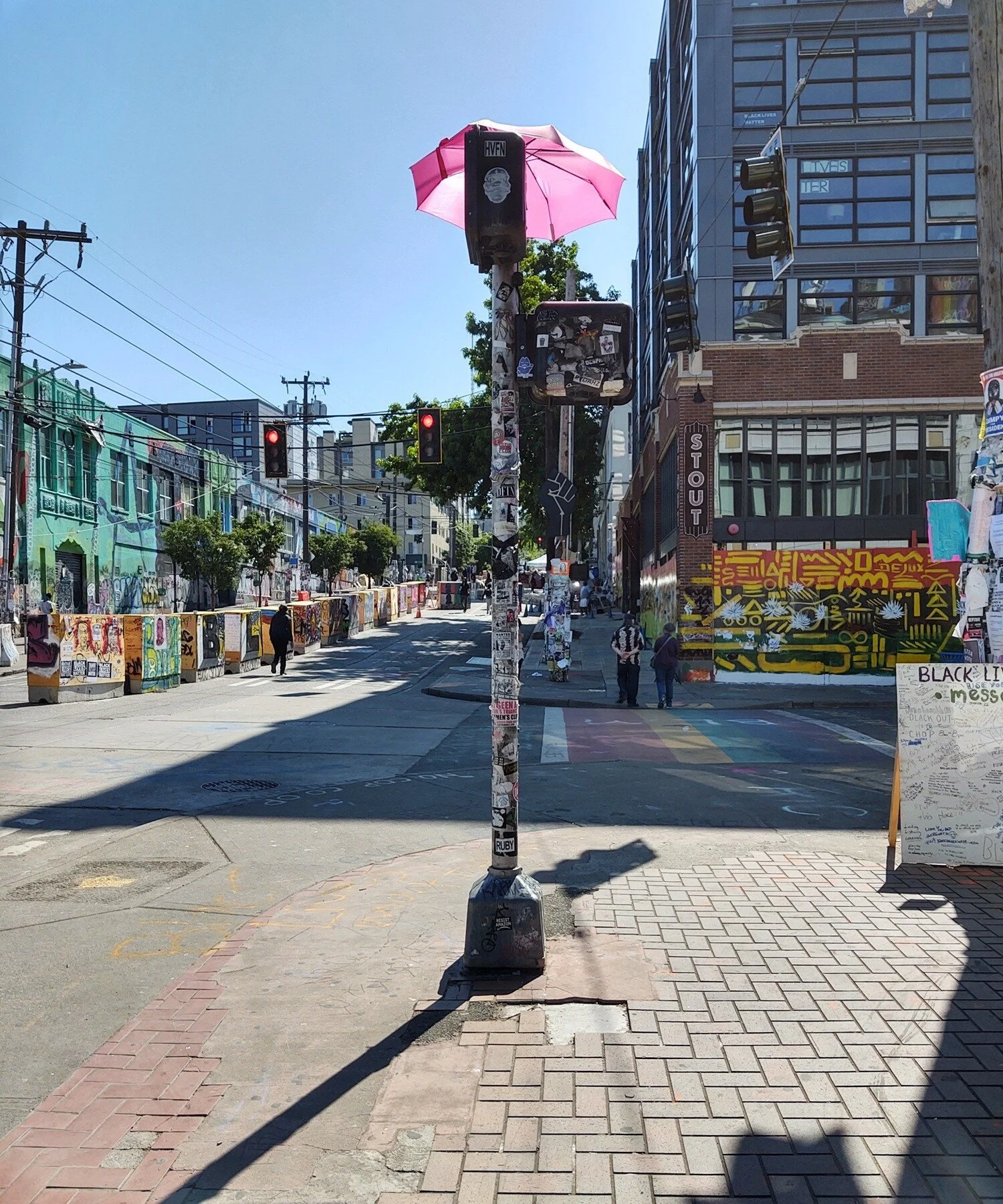
Pine St is divided by barricades as a few pedestrians walk through CHOP. (June 26)
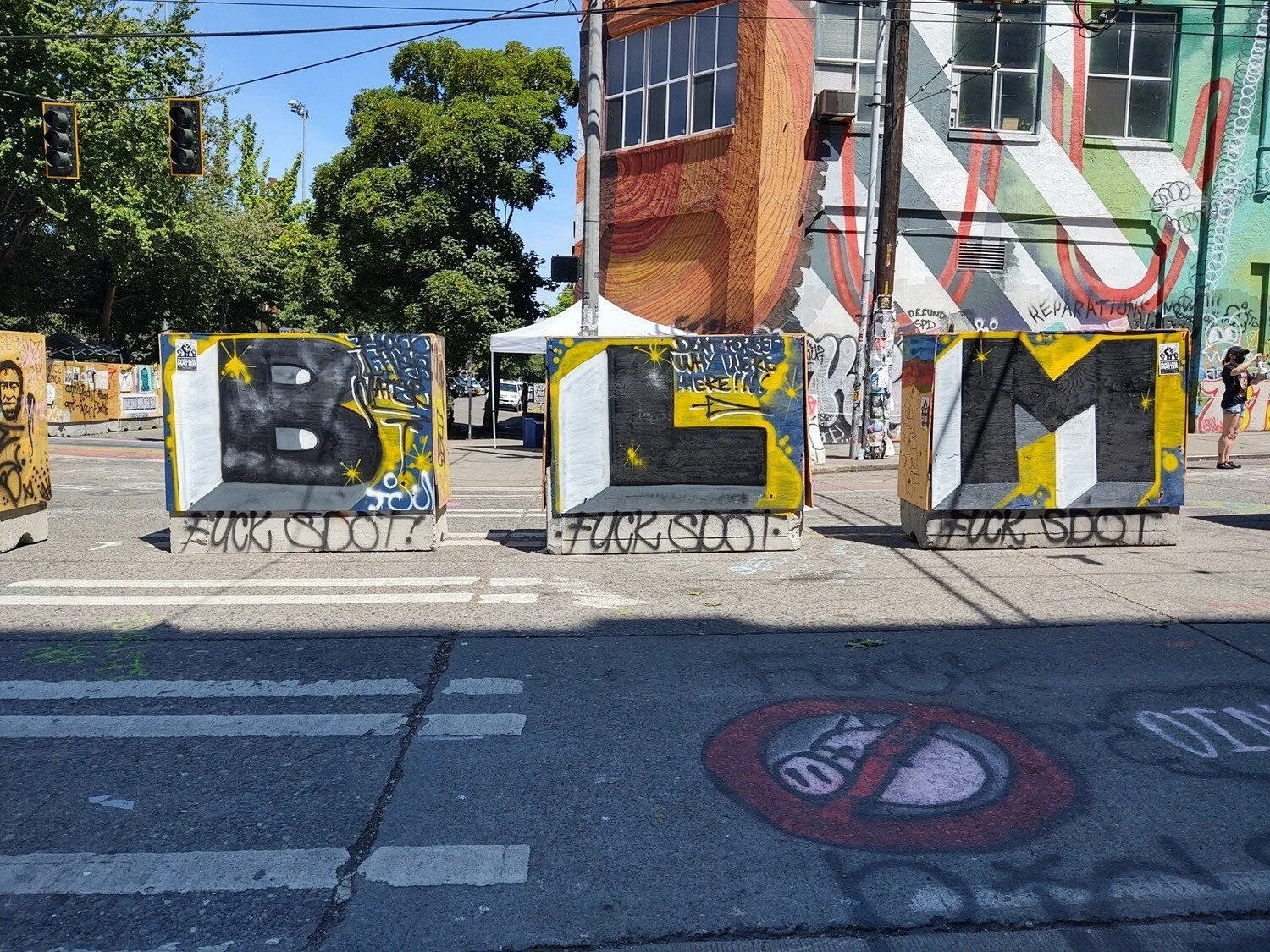
Barricades installed to assist first responder traffic.
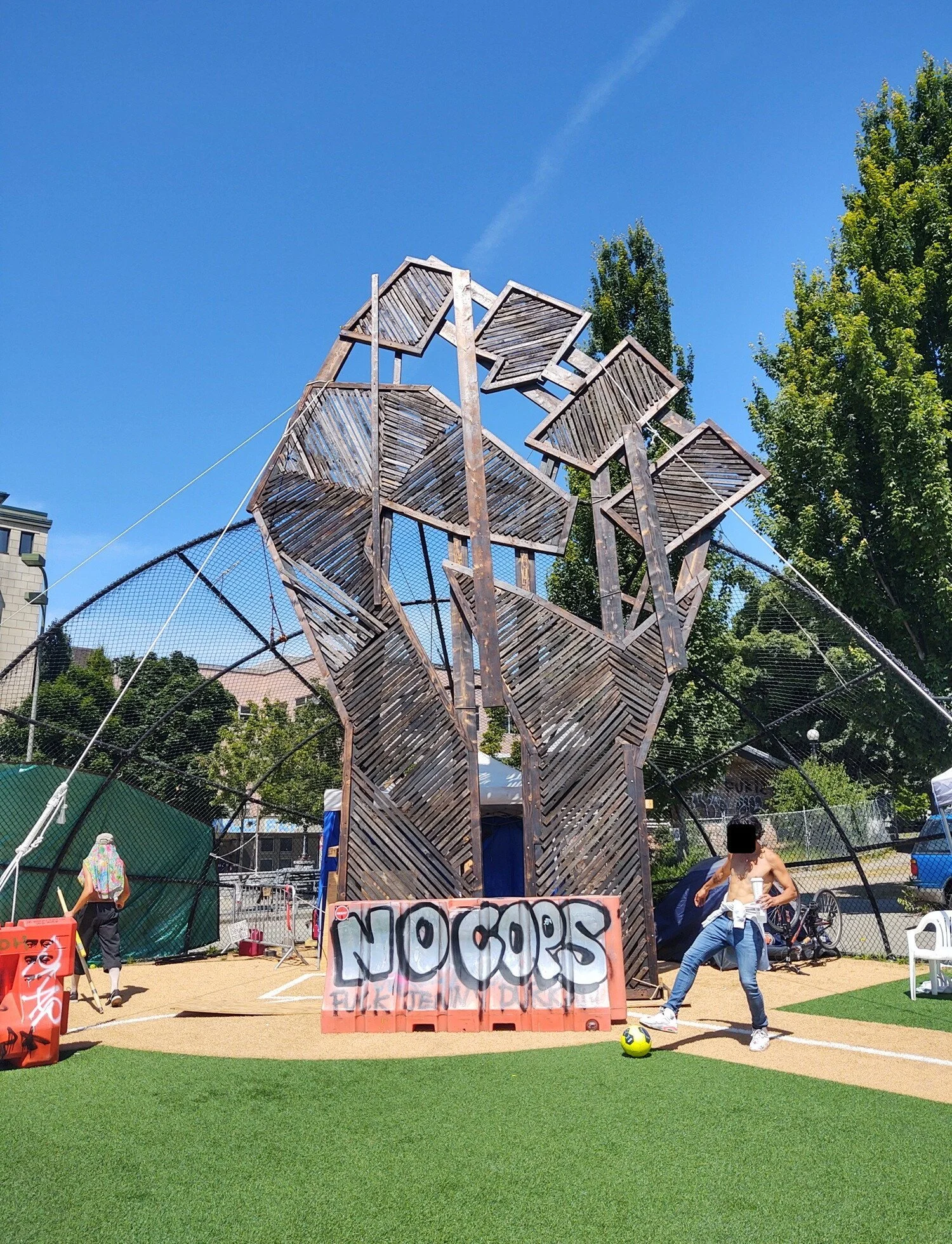
A person kicks a soccer ball near a large fist statue erected in Cal Anderson Park.
I didn’t completely buy into the collective’s messaging about moving beyond CHOP. I saw the collective as an organizing space rooted in the encampment, not separate from it. The protest was still ongoing. What were we going to do about the thing we’d started? We hadn’t gotten any demands yet. The unhoused population that had come there for protection from sweeps was still there. People had quit jobs and traveled across the country to participate in CHAZ/CHOP. Personally, I didn’t intend to move on until at least one of our demands were met.
One day in late June, I was texting with Leah and learned that she was on the way to meet with a local BLM leader who ran Nonprofit C. We'll call him "Mr. Charles." Nonprofit C was a highly visible BLM organization in Seattle, and Mr. Charles was a vocal critic of the encampment.
Overall, I had a positive perception of Mr. Charles when I first moved to Seattle, even if I found him to be a character. I had attended and appreciated some of his organization’s BLM protests. I fondly remember one event in particular. It brought together people from multiple communities affected by police violence. I'd even told him how much I appreciated his activism.
But something about Nonprofit C’s BLM events had shifted over the years. They seemed to take on a more moderate, police-friendly tone, as if the underlying issue was a lack of understanding between the public and the cops. By the time 2020 rolled around, Mr. Charles had a friendly relationship with both the police chief and the political establishment. He had lost the trust of some community members, although he continued to have support from others, especially those in the older generations and certain segments of the Black male population.
I was among those who had lost that trust, so I didn’t like the sound of this meeting. I told Leah to text me back afterwards.
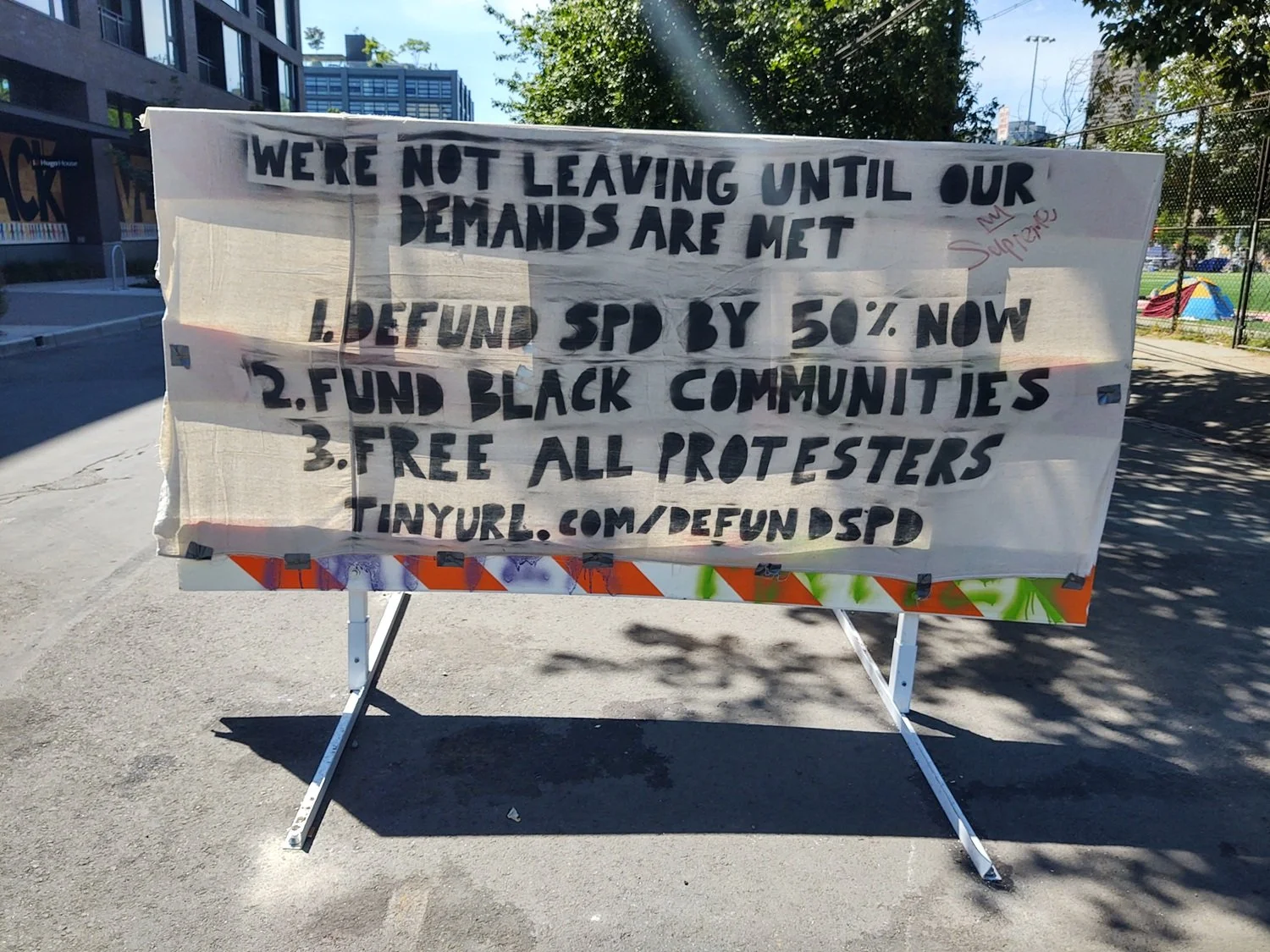
Protester demands (photo: June 25)
After the meeting, I learned that Leah, Kandy, and Kandy’s friend Bryndonn had attended the meeting along with a fourth person, a protester who was fairly active in the encampment. Leah told me that the group was going to meet with an elected Democrat the next day. I objected. Leah said I'd have to talk to Kandy and Bryndonn about my concerns. I found this annoying, since neither of them was an active participant in the encampment. Who were they to meet with anybody on our behalf? Who were they that Leah was deferring to them regarding my concerns?
I got Kandy and Bryndonn on the phone. They told me they were going to meet with the Democrat the next morning to be awarded $1 million. In return, they would publicly lead Black activists out of the encampment. (I can confirm these claims because there is a recording of the meeting.)
I spent hours on the phone with Kandy and Bryndonn trying to convince them to decline the money and instead ask for protester demands. We had several, including free any protesters who were in jail and defund the police by at least 50%. They seemed to be hearing me. Then I asked them what they needed my help with. They said they wanted help negotiating for more money.
The gall was a little astounding. Nonprofit B had never seen anything close to a million dollars. They were still trying to get off the ground, without any demonstrable record of financial success. There wasn't going to be any negotiation for more money. I asked them if they even knew Mr. Charles before this meeting. They did not. I told them that if they were given a specific dollar amount, then the dollar amount had already been decided by the person they were to meet with.
I noticed that they kept muting the line. I’m not sure if anyone else was in the room with them during this conversation.
By about 1 am, they had agreed to meet with the Democrat but decline the money, and ask for protester demands instead. They said they didn't feel confident about negotiating, so they asked me to go with them. I agreed. I sent them an email afterward to document the call, because Jesus Christ on High, I didn't want to get caught appearing to be complicit in what was going on here.
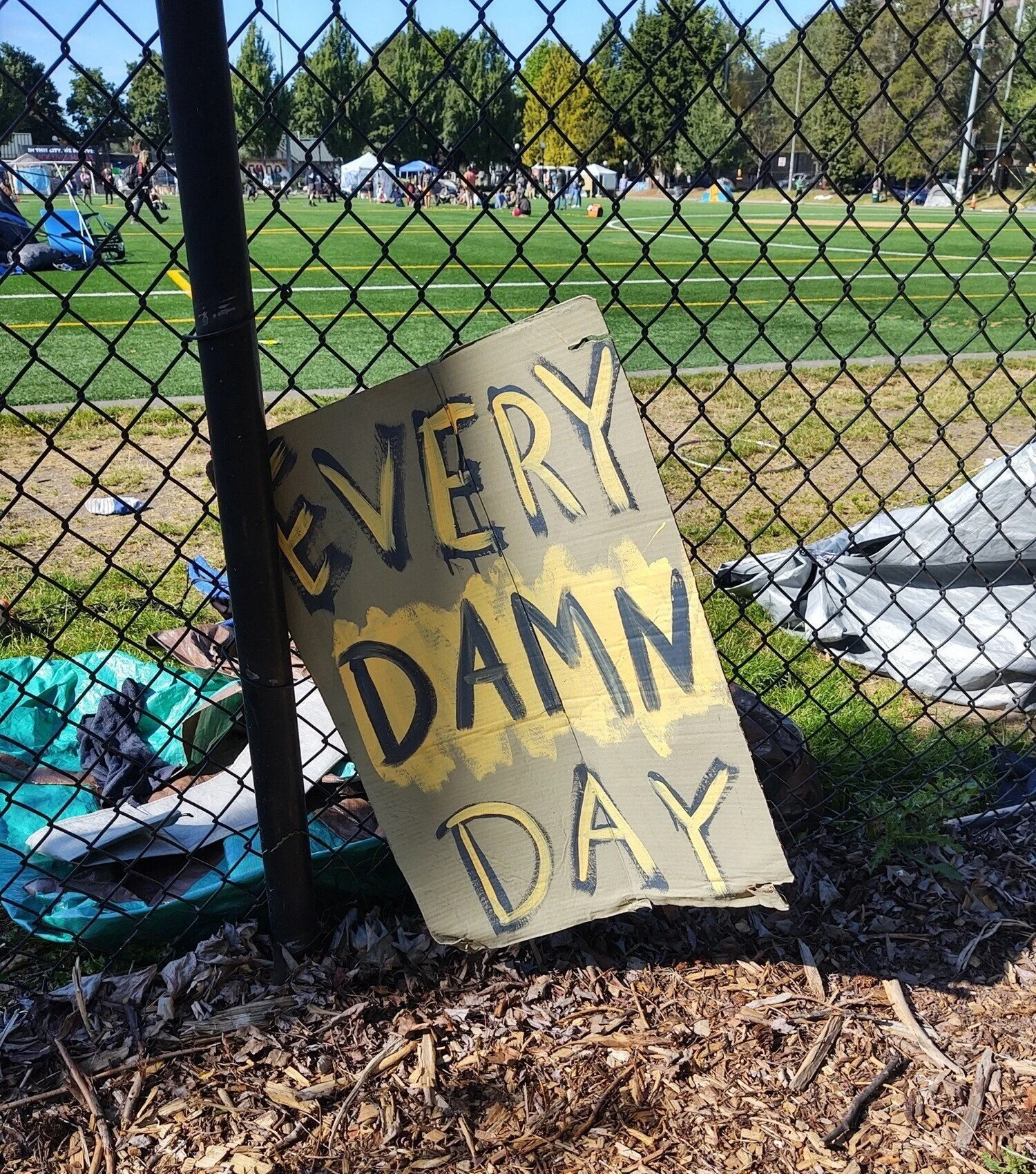
A smaller group of people than prior weeks is seen on Cal Anderson field as a protest sign leans against the fence.
I don't know why I didn't run far away from all of this, but I didn't. My priority in the moment was to stop the payout, and I had until the morning to do it.
To understand the mental state driving my decision-making, I suppose you'd have to understand just how all-encompassing CHOP had become; how normal it had become to experience something beyond the pale and then go get a taco, then listen to a 40-minute rant about gender dynamics on the security team, then be pulled aside to talk to a journalist, then help pull together sound equipment for an event, then hear a rumor that a semiautomatic weapon had been found leaning against a wall in an alleyway, then go spend time with your real-life community who had no idea what it was like to navigate the autonomous zone at this point.
I was living in a different world. Going into CHOP was like going into one of those stories where a person experiences a whole week of events, and then they wake up and only 30 minutes have passed in the real world. The encampment had its own time, its own logic. It had its own systems of accountability. It was a created reality, with many parties fighting for the role of creator, and I was spending too much time within that reality. I can't explain it any better than that.
I’ve thought a lot about alternative routes I could’ve taken at this juncture. Law enforcement was off the table, obviously. I knew a few journalists, but none who I could call in the middle of the night and entrust with this information. I guess I could've notified the collective, but these were the people who I knew in the collective. I could've gone to social media and broadcast what was happening to everyone that would listen, but in that moment, I felt defensive of people in the collective. I thought they were naive young activists who'd just had a lot of money waved in front of their faces, and I didn’t want to tell people that they’d said yes.
So I went to bed, and I got up early the next morning to prepare to meet with the Democrat.