Part 9: Styrofoam
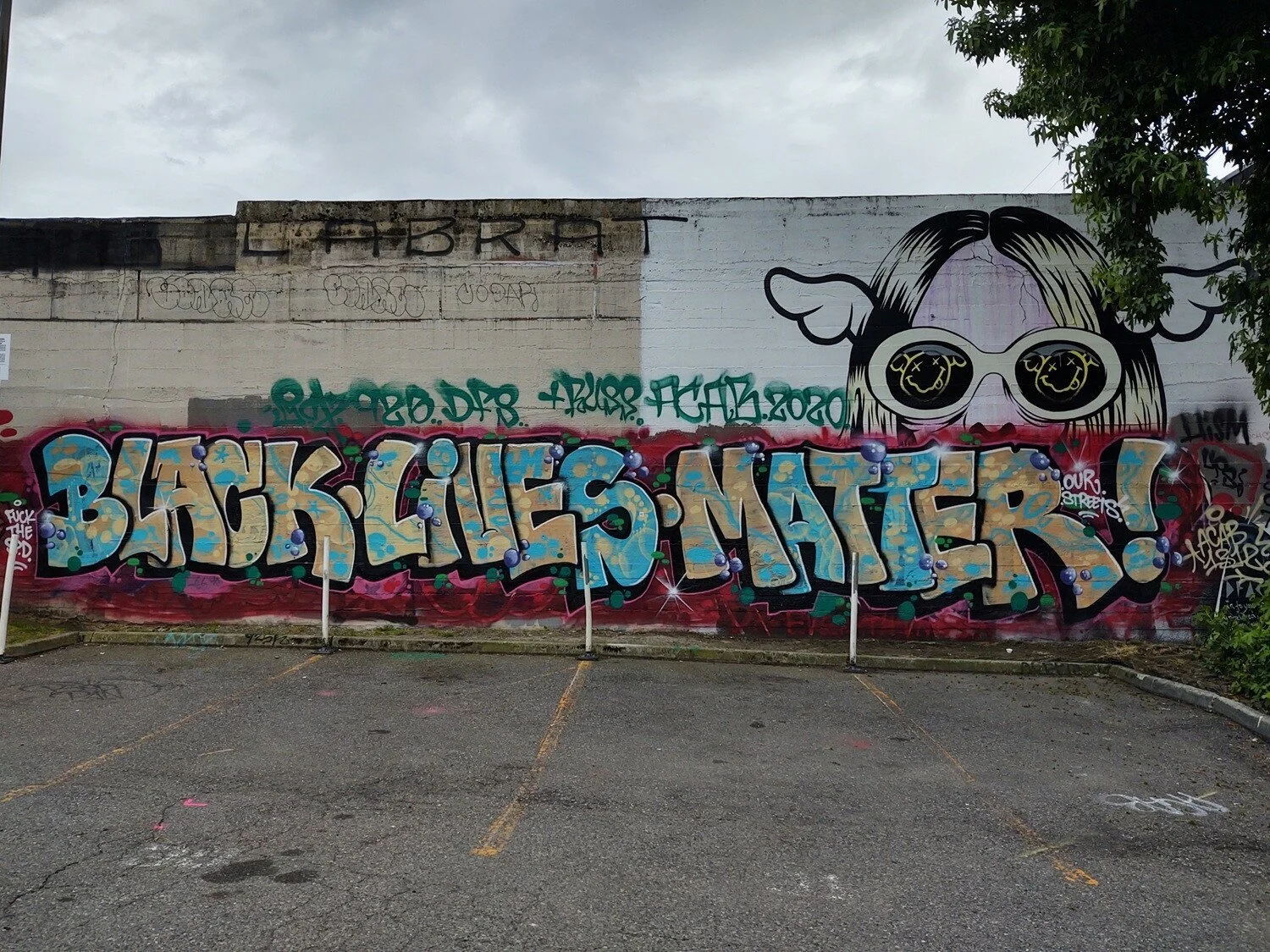
A Kurt Cobain mural blends with a BLM mural in the Ranchos Bravos parking lot, July 2020. All photos: Tarika Powell
Contents: An alleged bag full of guns; multiple people try to get me involved in PPP loans; the feds infiltrate my family
Note: These essays reflect the author's present recollection of events. Some names and characteristics have been changed.
Previously in this series: Part 8: The end of CHOP
The final week of CHOP was also the apex of the collective. We had a meteoric rise within Seattle’s BLM activism scene, and disappeared just as quickly.
One night, not long after the business with Mr. Charles and the Democrat, Kandy messaged me. She indicated that there was an unspecified emergency. There was always some sort of emergency, especially as the protest drew to a close. She sent me her address.
I got to her apartment expecting to meet with the usual suspects, but only Kandy and Kim were there. The two of them started chit-chatting as though there was no emergency. They offered me food and something to drink. There was a bustle of activity in the kitchen as I sat at the dining table wondering what was going on.
They served me Indian food from a styrofoam container. I hadn’t seen styrofoam food containers in years. It was illegal for restaurants in Seattle to serve food in styrofoam. The lentils were cold and watery. The naan was as crispy as a cracker. I nibbled to try to be polite.
Once they sat down at the table, they continued to not tell me what the emergency was. Instead, they asked me to work for them. I tried to steer away from the subject because it was a pretty insulting idea. I said I didn’t want to get paid for my activism, which was true. They worked their way around to asking me again, and I declined again.
Based on their own statements, the nonprofit barely existed except on paper. It had only just launched a website. There was no independent board. I saw no history of successful fundraising prior to June 2020 and no demonstrated stability. What money were they going to pay me with? To do what? While I didn’t know what the nonprofit specialized in, I knew it didn’t specialize in fossil fuels.
I asked about the alleged emergency. Kim did most of the talking. They claimed to have a recording of someone from CHOP, a Black man, receiving a duffel bag full of guns from the police.
I knew the man. I’d seen him around for several weeks. He was one of several people who took to listening to my conversations with the press towards the end of CHOP. On one occasion, one of them loudly interrupted my interview from across the street and shouted at the journalist not to talk to me. This particular guy had never directly disrespected me, unlike several other men at the protest.
I asked several questions. I was curious how they got ahold of this recording when they were not actively involved in the encampment. They didn't give specifics, but it was feasible that Kandy's newfound micro-celebrity (since the press conference) could've led someone to trust her with the information.
I asked if they wanted to get it to the press, because that’s the only reason I could think of for them to call me about this instead of someone else. Kandy still hadn’t told me whether she wanted to leak the tape with Mr. Charles. I’d already reached out to some people. They’d told me the tape was dangerous information. Some didn’t want to hear anything about it. I’d been told that I shouldn’t go to Seattle news outlets, and I’d have to get it out of Seattle. The first tape was already stressing me out, and now they were telling me about a second one.
Kim said, "I'm not with that leaking stuff. I'm trying to get paid!"
Taken aback, I asked if the video showed what was in the bag. They said it didn't. So how did they know there were guns in the bag? They said the bag looked heavy, that you could tell it was guns based on how the bag looked. They said they could play the video for me. I refused to watch it. I told them they should forget they had seen it. I wrapped up the conversation and I went home.
I didn’t tell anyone about the Indian food meeting, but I trusted these people far less after that. Kandy, Brynndon, and Leah started spending a lot of time at Kandy’s house and giving the collective more top-down updates, announcing as fact things that the collective should’ve been voting on. I took umbrage to being treated like an unpaid employee of the nonprofit, because I had never elected any of them to be my manager.
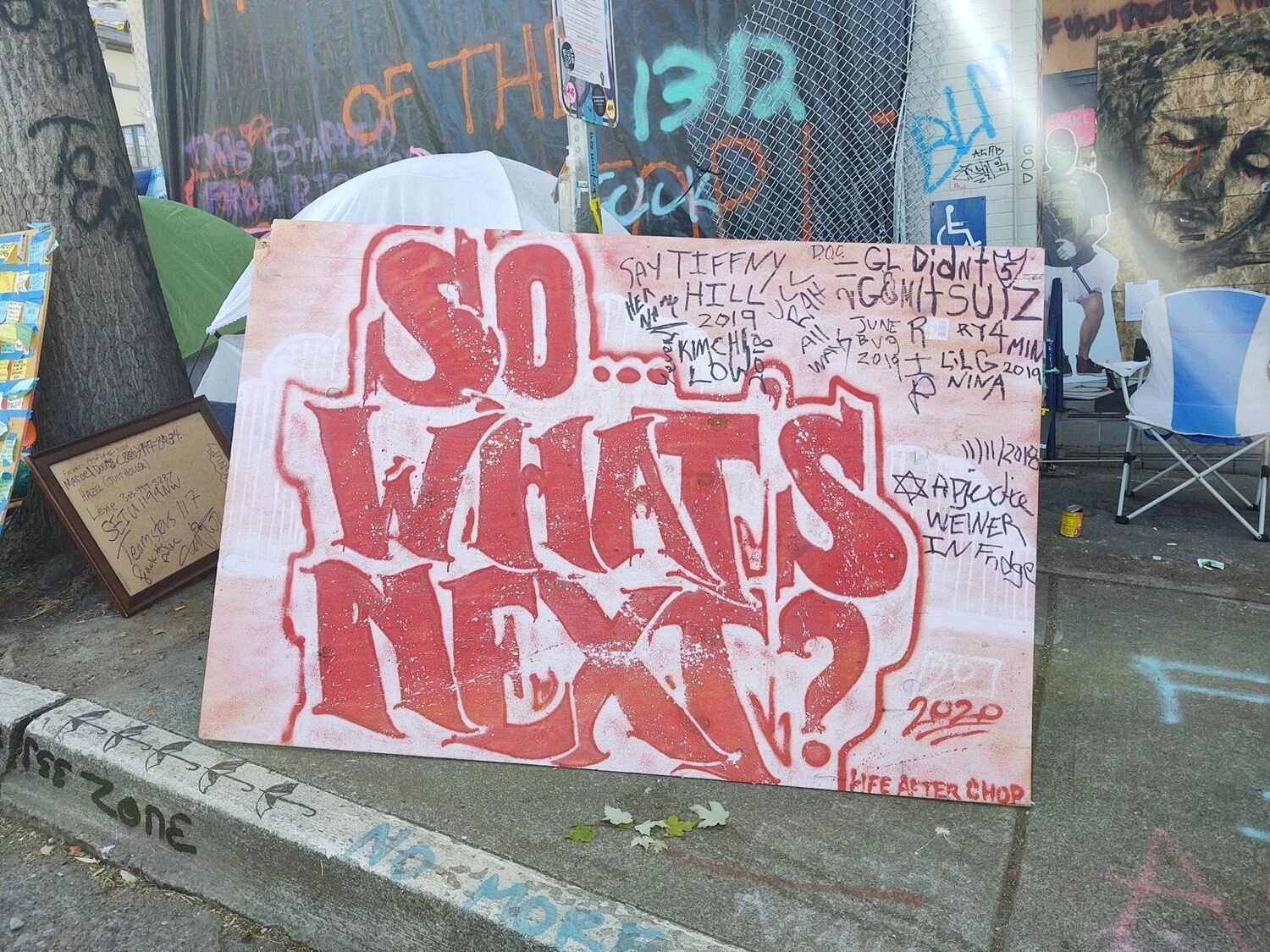
A sign in CHOP asks, “So what’s next? Life after CHOP.” Photographed on June 25, this sign was at the protest at least a week before CHOP was shut down by the City.
Accounting
Despite having about a dozen committees in the collective, there was no finance committee. People trusted Nonprofit B to handle the money because they ran a nonprofit. They were receiving funds on our behalf, including money raised at our events, but there was no fiscal sponsorship agreement in place. (A fiscal sponsorship is a legal requirement when a nonprofit handles funds on behalf of a third-party organization.) Also, thousands of dollars for the collective were going into a Venmo they’d set up. The majority of us didn't know any details about the money we were bringing in.
I sat on my concerns for a little while. Then I needed to coordinate some payments the collective had pledged to a third-party group. I was the collective’s liaison with this group, and had agreed not to reveal any information about their membership because they had a “safety concern” (their words) about someone in the collective. So I had to be the one to coordinate the payments.
I had a rough estimate of how much money was in the Venmo because I ran the collective’s email account, and got an email every time someone donated. I made an Excel sheet to start tracking all the money that came in, but I didn’t have access to the account itself so I added up the donations using the emails.
I asked for access to the Venmo so I could pay members of this other organization. Leah and Brynndon sent me multiple messages saying they would take care of it. This raised a red flag. I talked to Pamela about my concerns. We called a meeting with Kandy, Leah, and Brynndon.
When I got to Kandy’s apartment, Leah was getting an in-home haircut in the dining room. She claimed there was no other time to schedule the service. The rest of us sat on or around a large bean bag in Kandy's living room, which was the only piece of sitting furniture in the room. Kandy sat to my right on the floor. Pamela leaned tummy-down on the bean bag to my left.
The clippers were very loud, and Leah wanted to be able to join us in the living room for the financial conversation, so we had to wait to start the meeting. We ordered pizza. I asked Brynndon and Kandy what they wanted to do about the tape. They said they wanted to “hold off” on releasing it. By the time the haircut was finished, 30 to 45 minutes later, Kim had just walked in the door with a young lady I’d never seen before. They’d driven up from out of town.
Kim pulled out one of the dining room chairs and took control of the meeting. She said she had taken a training in mediation, so she knew how to mediate conflict. She bounced around several different subjects, then she said she had gotten a lot of people PPP loans that summer. She said she’d made a lot of money from her cut of the PPP loans. She'd gotten a loan for Leah, and offered to get loans for myself and Pamela. Pamela was also unemployed, and she expressed interest. Kandy interjected to say the program they'd applied through was over now. Brynndon and Leah agreed that they’d also heard the program was closed. Once Pamela picked up what they were putting down, she looked at me and stopped talking.
I had no interest in the PPP loans, but I had a big problem with that activity being mixed up in the collective. It made us vulnerable to the feds using crime as a pretext for political persecution, and it certainly did not give me any confidence in them as financial managers.
Pamela complimented Kandy’s apartment. Kandy expressed surprise that Pamela hadn’t been over before and, gesturing at me, said, “I know you’ve been here…”
I said I hadn’t been there either. Then Kim helpfully reminded me that I’d been there for the Indian food meeting, and proceeded to tell the whole room, including the barber, about the alleged bag full of guns.
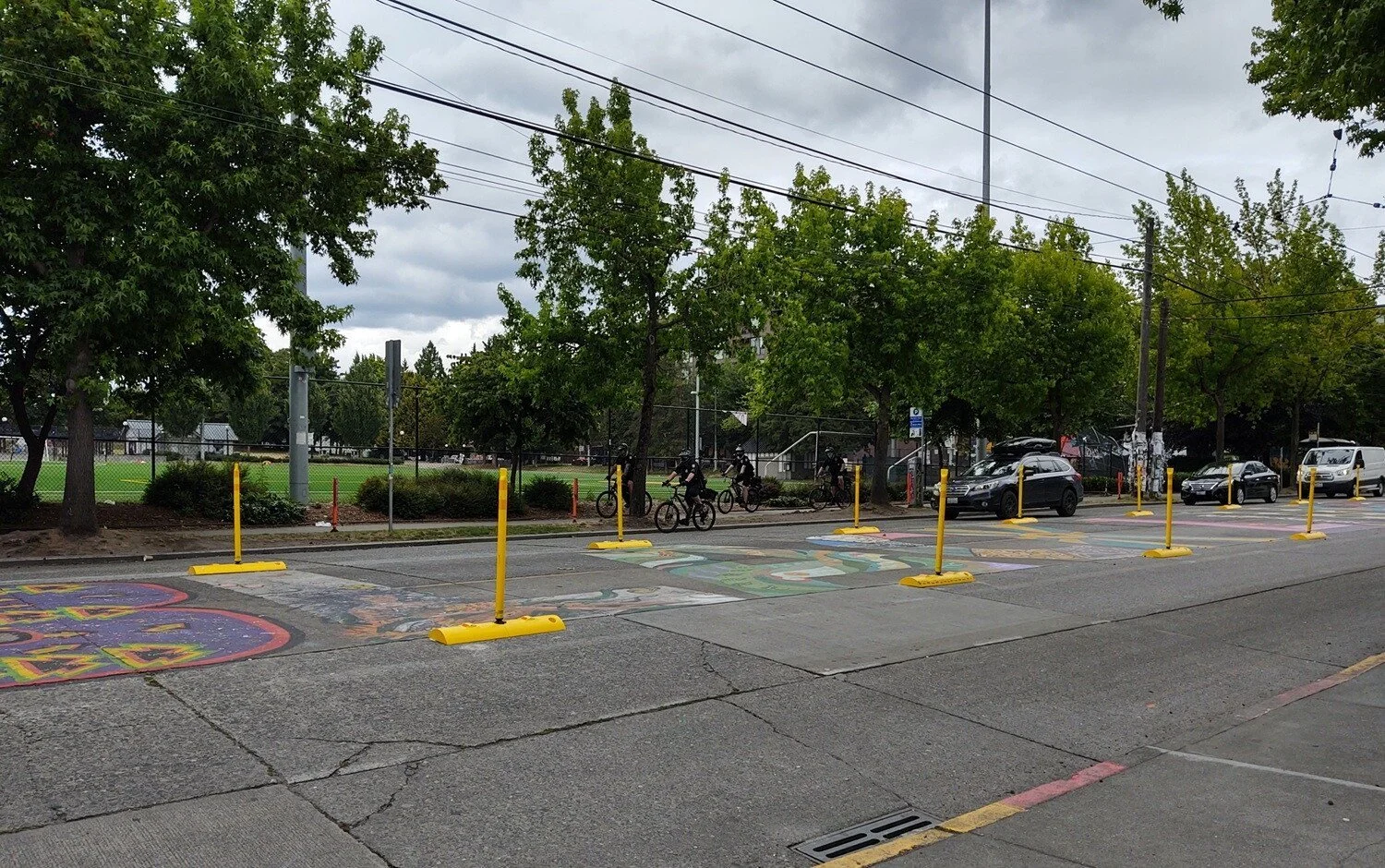
Bike cops ride past the Black Lives Matter mural on July 09, 2020, a week after the end of the CHAZ/CHOP protest.
I asked Kandy some specific questions about the money. She said they were “still deciding” who was going to have their name and tax information attached to the Venmo. I expressed concern that my reputation was tied to the collective’s proper stewardship of the funds.
Pamela complimented Leah on her haircut, and the two of them started playfully flirting. I was now on enemy turf with no back-up. Even the man who cut Leah's hair was looking at me funny.
A piece of the weight I had been carrying since May 30th broke free. All the helicopters flying over my neighborhood, the teargas, the gunshots, the endless CHOP emergencies, the deaths of those two boys, the tapes, the money… I just started crying. Everybody went quiet. The silence in the room was heavy and cold. I got up and left Pamela there.
There was a whole-collective meeting about an hour after I left Kandy’s house. I’d told them I wasn’t going to attend, but I logged on remotely without saying anything. That’s when I heard Kandy announcing that she was going to control the Venmo and it would be in her name.
I went to the whole collective regarding my concerns about the money. Nonprofit B had belatedly scheduled some meetings about becoming our fiscal sponsor. I cancelled them. I demanded that Kandy give us receipts for any of our money that had already gone to the nonprofit, and gave a deadline. Kandy quit the collective and stopped communicating with us in group channels.
The ensuing conflict killed the collective. It’s hard to form a cohesive organization when people don’t know one another. You can form something that looks like a collective and call it a collective, but longevity is going to be elusive. Conflict is difficult to navigate in a space where there is no earned trust.
The process of getting information about the money and setting up appropriate financial structures dragged on for a long time. People stopped showing up for meetings. Nonprofit A disappeared one day, never to be heard from again. I quit the collective before the issue was resolved. I was thoroughly over nonprofits and their relationship to communities of color, not just within the collective, but in general.
I got a red light ticket in the mail from the night of the Indian food meeting, from a light not far from Kandy’s house.
Then I got a call from a relative I hadn’t spoken to in years. They told me they’d gotten thousands of dollars through multiple PPP loans that summer, and they knew someone who could get one for me. They said this person could get a loan for anybody, even if you didn’t have a business.
I suppose that’s when I knew for sure the feds were trying to take me down.